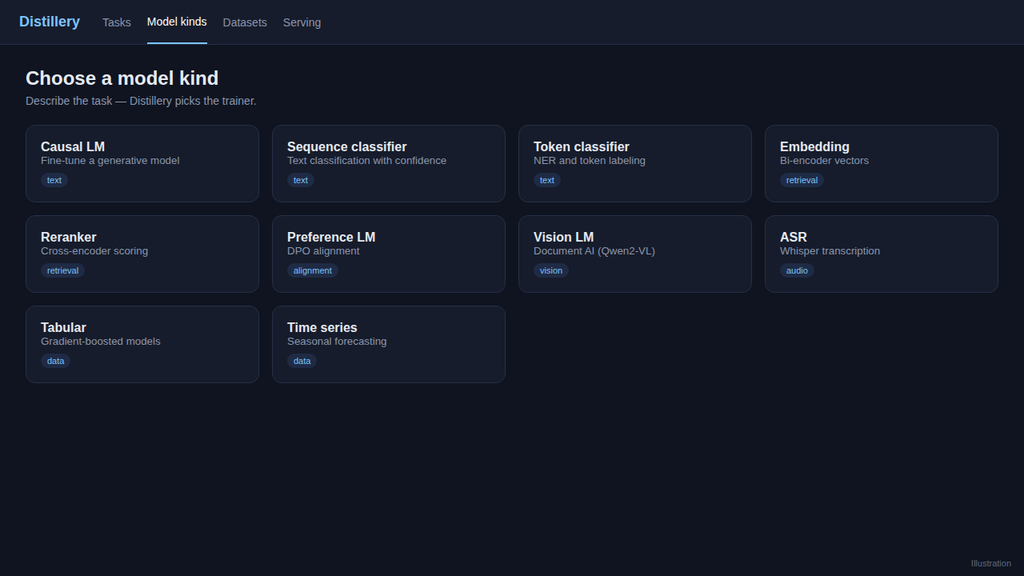
Distillery 1.2.0 is out, and it is the biggest step the project has taken so far. What started as a fine-tuner for causal language models is now a multi-kind task-to-model platform: ten model kinds, a real llama.cpp serving backend, and schema-constrained decoding.
There are no breaking changes. Existing causal-LM tasks migrate automatically.
Ten model kinds
Release 1.2.0 adds support for the following kinds, each with its own training path:
seq_classifier: text classification with confidence scores.
token_classifier: named entity recognition and token labeling.
embedding and reranker: bi-encoder and cross-encoder models for retrieval pipelines.
preference_lm: DPO-based preference alignment.
vision_lm: document AI built on Qwen2-VL.
asr: Whisper speech-to-text transcription.
tabular: gradient-boosted classification and regression.
time_series: forecasting with seasonal methods.
Infrastructure upgrades
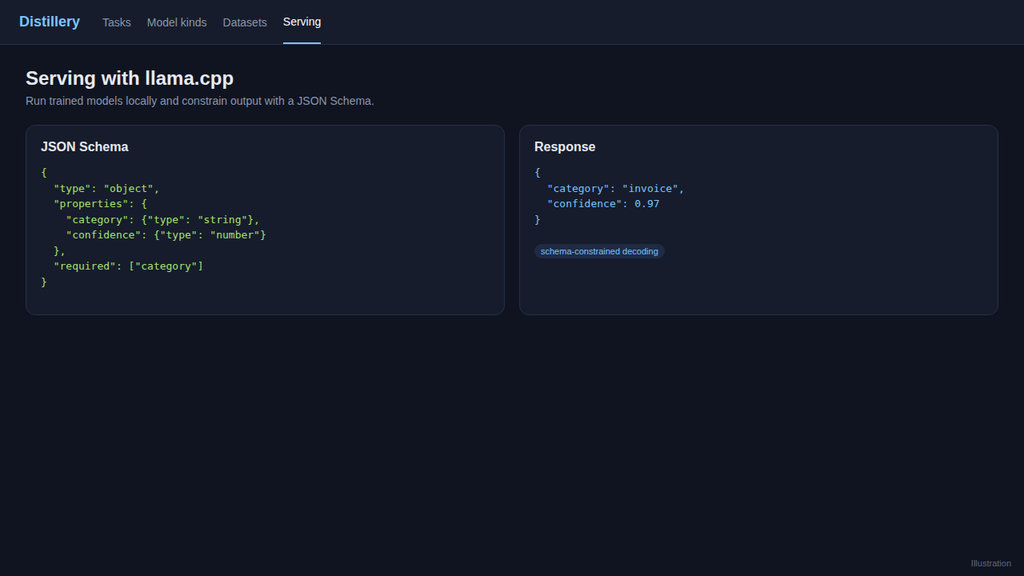
Under the hood, 1.2.0 brings a unified Python trainer architecture shared by all model kinds, llama.cpp inference backend support for serving, JSON Schema constrained decoding so model output follows the structure you define, local blob storage, and PDF rasterization for document workflows.
New tabular analysis page
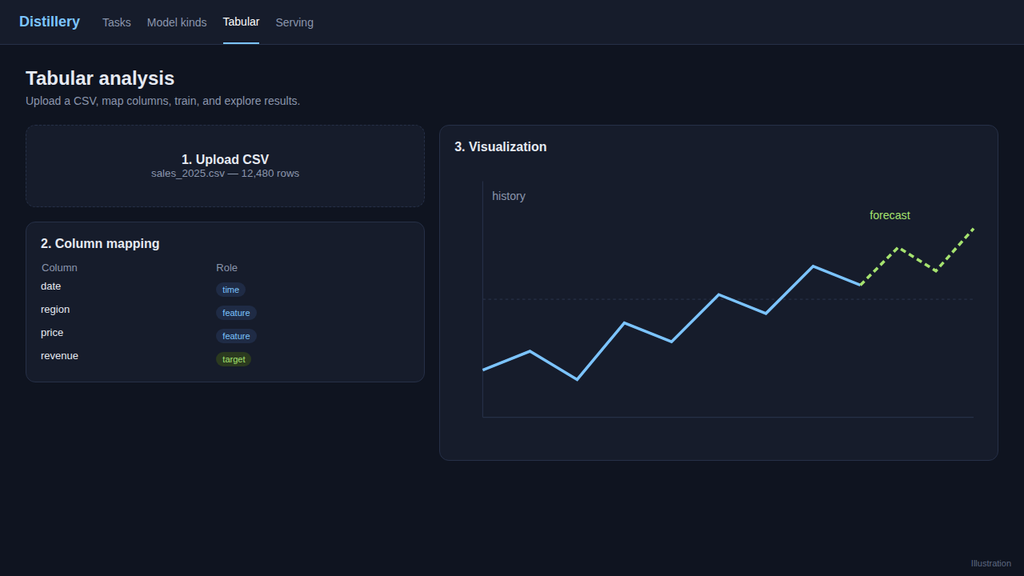
The web UI gains a tabular analysis page. Upload a CSV, map your columns, and use the built-in visualization tools to explore your data and results.
New API endpoints
The release introduces routes for vision and ASR import, embedding, reranking, transcription, forecasting, and batch prediction.
Documentation
Four new guides ship with the release: embeddings and rerankers, vision-language document AI, speech ASR, and tabular forecasting.
Upgrade notes
There are no breaking changes, and existing causal-LM tasks migrate automatically. Optional GPU-dependent features are still experimental and are not required.
Get Distillery 1.2.0
Download the release and read the full notes on GitHub: https://github.com/AIHelpers/distillery/releases/tag/1.2.0
Leave a Reply